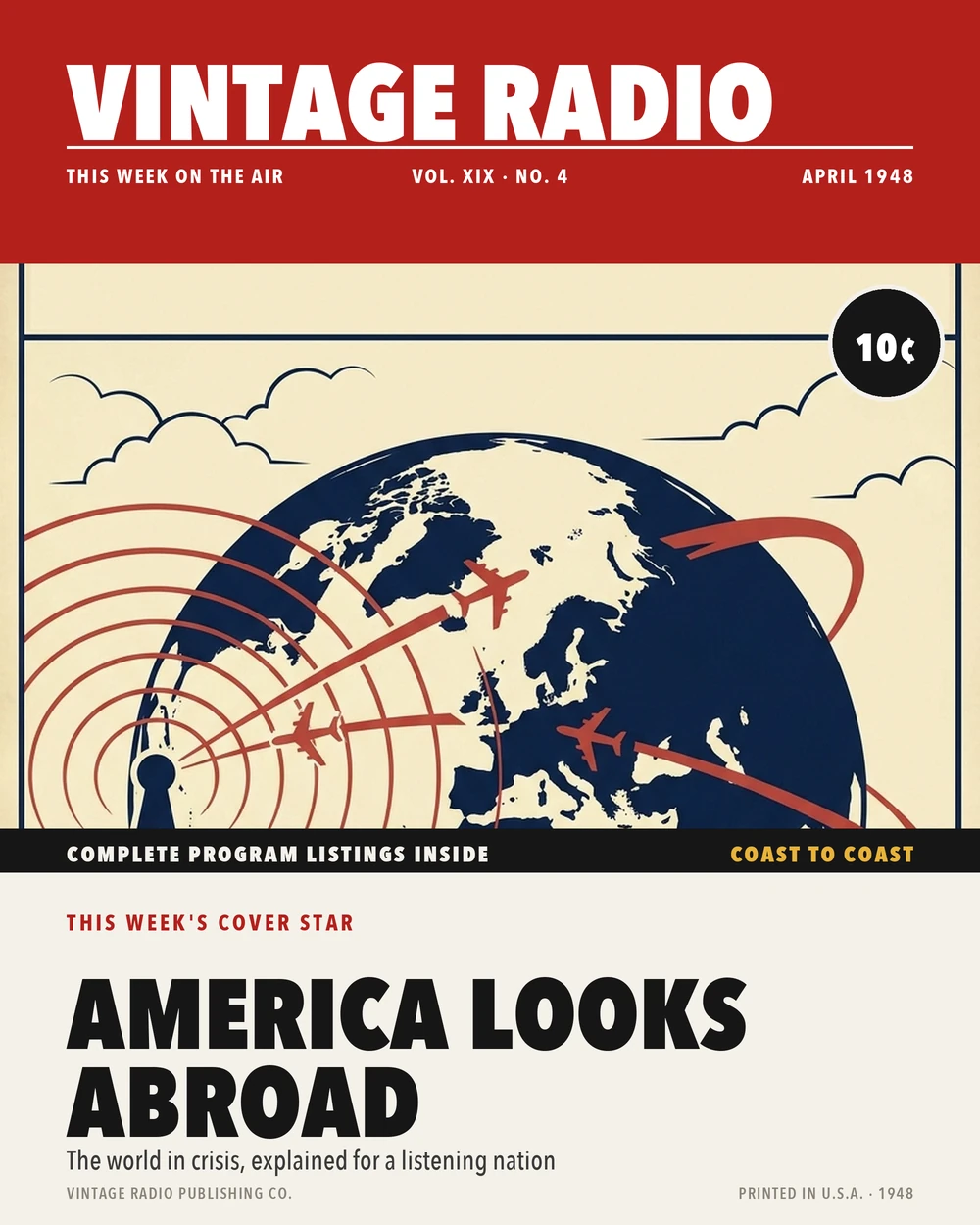
America Looks Abroad
A Nation Trying to Understand a World at War
When America Looks Abroad went on the air January 7, 1940, Europe was already at war. Germany had invaded Poland four months earlier, Britain and France had declared war in response, and the United States was watching nervously from across the Atlantic — officially neutral but hardly indifferent. Into that moment stepped the Foreign Policy Association, a nonpartisan civic organization that had been working since 1918 to educate American citizens about international affairs. Their vehicle was a 15-minute NBC program that aired throughout 1940, and its purpose was blunt: help ordinary Americans understand what was happening in the world and what their country's role in it might become.
The Foreign Policy Association had deep roots in that same educational mission. Founded originally as the League of Free Nations Association in 1918 to support Woodrow Wilson's Fourteen Points peace proposal, it was reconstituted as the FPA in 1923 and spent the following decades pioneering public education on international affairs. One of its tools was radio — the FPA had been broadcasting New York meetings and weekly talks over NBC for years before America Looks Abroad gave that effort a more structured weekly form. The show was a direct outgrowth of that work, applying the FPA's civic-education philosophy to the most urgent foreign-policy moment Americans had faced since 1918.
What the Episodes Covered
The surviving episode titles read like a compressed news history of 1940. Early in the year, episodes examined "Is Europe Ready For Roosevelt" and the sinking of the German pocket battleship Graf Spee. By spring the coverage tracked the rapid deterioration on the continent — "Germany's War Aims In Scandanavia," "Scandinavia On Firing Line," and "War Spreads In Europe" followed the German campaigns in the north, while "Germany Has Invaded Holland" marked the opening of the western offensive in May. Summer brought episodes on "UK Prepares For Invasion," "Germany Strikes At Britian," "Britain's Home Front," and "Plight Of Britain" as the Battle of Britain took shape. By fall and winter, the series was weighing "American Aid To Britain," "America's Choice In Europe," and "Axis Prospects In The Balkans," closing out the year with "War and Peace Prospects for 1941."
Running alongside the European coverage were episodes that looked closer to home — "The American Republics Face War" addressed the position of Latin American nations, and "Can America Defend Neutrality" put the central domestic question of the moment directly in the title. The series also went inside the belligerent nations themselves, with episodes called "Inside Germany" and "Inside England" that examined conditions and attitudes on the ground. The breadth of the coverage, all compressed into 15-minute installments, reflected the FPA's conviction that citizens needed context, not just headlines.
How the Program Was Put Together
Each episode typically featured a talk or discussion by someone associated with the FPA, working through the analysis of specific events, decisions, and the people driving American foreign policy. Rather than straight news reading, the format engaged with secretaries of state, military leaders, and diplomats — the personal stories and motivations of figures actually shaping policy. That blend of analysis and personality was deliberate. The FPA's goal was to make international affairs accessible to a wide audience, and pairing policy analysis with the human dimension of decision-making was the way to hold a general listener through a 15-minute examination of, say, the strategic situation in the Balkans.
NBC was the right home for this kind of programming. The network had a tradition of public-affairs broadcasting, and the FPA's existing relationship with NBC — built through years of carrying its New York meetings and weekly talks — made the arrangement natural. The show sat in the same broadcast landscape as Edward R. Murrow's London reports and H.V. Kaltenborn's commentary, part of a broader effort by American radio to make sense of a world that had suddenly become impossible to ignore.
A Short Run, a Specific Moment
The series ran entirely within 1940, with the catalog capturing 45 episodes from January 7 through December 29 of that year. The broader run, drawing on other sources, appears to span from sometime in 1939 through May 1941 — but the 1940 broadcasts represent the heart of it, the year when the shape of the war became clear and American neutrality came under its heaviest stress. Every episode title that has been corroborated points to pre-Pearl Harbor events in Europe and the Americas. This was a show made entirely for a country that had not yet entered the war and was still debating whether and how it should engage.
That context matters for understanding what the program was and wasn't trying to do. It wasn't offering hindsight or historical perspective — it was providing analysis in real time, as German forces moved through Scandinavia, as France fell, as Britain braced for invasion. The FPA's nonpartisan framing gave the series a particular character: it wasn't advocacy for intervention or isolation, but an effort to lay out the facts and stakes clearly enough that listeners could form their own views. Whether that balance was fully achieved across 45 episodes is hard to judge now, but the intent was genuine to the FPA's founding mission.
What Survives
Forty-five episodes are held in the broadcast catalog, covering the full run of 1940 broadcasts. The surviving titles alone give a detailed picture of how the series tracked the war's progression month by month — from the phony war of early 1940 through the fall of France, the Battle of Britain, and the opening debates about American aid. For a 15-minute public-affairs program from a pre-Pearl Harbor moment when American involvement was still genuinely uncertain, that's a substantial record of how one serious organization tried to prepare citizens for decisions their country had not yet made.